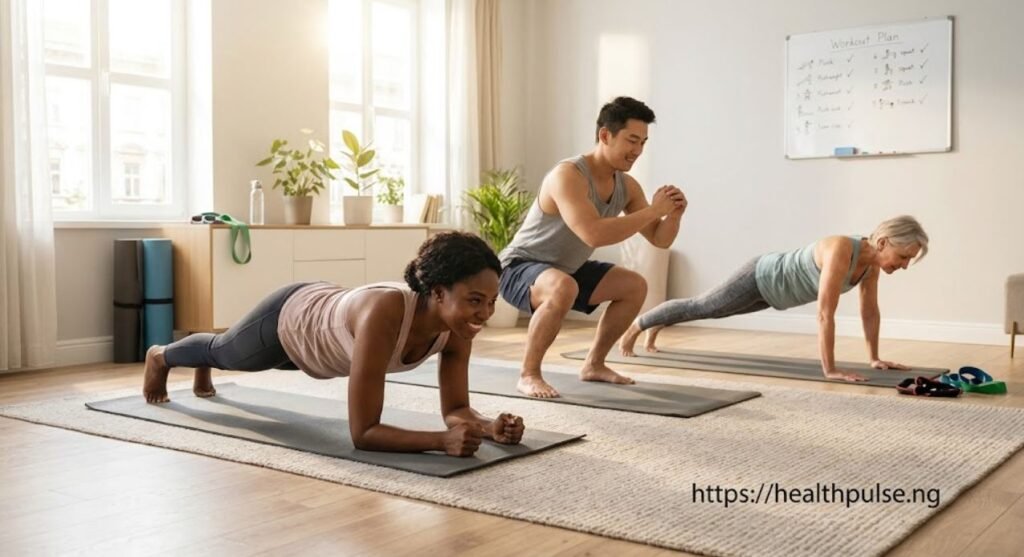
Plenty of people stay sedentary just because they think they need a gym membership to get fit. The truth is, you can build serious strength, heart health, and muscle using nothing but your own bodyweight. There’s a reason those classic prison-yard physiques look the way they do. Here is how you get started with home workouts without equipment.
The core exercises
You can scale every move you do to match your current strength:
- Push-ups, wall → incline (hands on counter) → knee → full → feet-lifted
- Squats, chair-helped → bodyweight → pause squats → split squats → Bulgarian split squats
- Lunges, static lunge → reverse lunge → walking lunge
- Hip hinges, glute bridge → single-leg bridge → hip thrust
- Core, dead bug → plank → side plank
- Cardio, marching in place → jumping jacks → high knees → burpees (optional, humbling)
A beginner full-body routine
Try this circuit three days a week. Perform each exercise for 30–40 seconds, rest for 30 seconds, and aim for 3–4 rounds:
- Incline or knee push-ups
- Chair squats
- Glute bridges
- Standing bird-dog or dead bug
- Marching or step jacks
An intermediate plan
Once that beginner circuit feels like a breeze—usually after 4–6 weeks—it’s time to start tracking sets and reps:
- Full push-ups: 3 × 6–12
- Split squats: 3 × 8–12 per leg
- Single-leg glute bridge: 3 × 10–12 per side
- Plank: 3 × 30–45 seconds
- Finisher: 5 minutes of 30-seconds-on/30-off high knees or jumping jacks
How to keep progressing home workouts without equipment
No barbell? No problem. You can keep getting stronger by playing with leverage and tempo instead:
- Harder variations (knee push-up → full → decline → archer)
- Slower reps (3–4 seconds down) increase tension dramatically
- Pauses at the hardest point remove momentum
- Single-limb versions roughly double the load per side
- Shorter rests or more rounds raise the cardio demand
A sample weekly structure
- Mon: Full-body strength circuit
- Tue: Brisk 30-minute walk
- Wed: Full-body strength circuit
- Thu: Walk, mobility, or rest
- Fri: Full-body strength circuit
- Weekend: Active fun, hike, dance, sport, long walk
Common mistakes
- Doing random workouts daily instead of a repeatable plan
- Rushing reps with poor range, slower and deeper wins
- Skipping legs because they’re hard (that’s the point)
- No progression, the same workout forever maintains, never builds
- All intensity, no recovery, 3 quality sessions beat 7 sloppy ones
Key takeaways
- Six fundamental movements, scaled to your level, cover everything.
- Progress via harder variations, slower tempo, and single-limb work.
- Three structured sessions a week plus walking is a complete plan.
FAQ
Can you build muscle with no equipment?
Yes, especially as a beginner. Once basic moves get easy, harder variations and slow tempos keep the challenge high enough for growth.
How long should a home workout be?
Twenty to forty minutes, done consistently. A perfect 20-minute session you repeat beats an abandoned 90-minute one.
Are home workouts enough for weight loss?
They help enormously, but fat loss is driven mainly by food intake. Pair training with a modest calorie deficit and adequate protein.
